Breamlea, Victoria

Breamlea, Victoria
Showing posts with label John Armstrong. Show all posts

Tuesday, 19 January 2016

Cobram and the Man with Two Names Part Two

Me at the gates of Cobram cemetery - January 2016.

Cobram and the man with two names

While searching for the siblings of my gg grandmother Louisa Clarke, I finally lucked onto the burial of her brother JOHN in Cobram, Victoria in 1931. 

I have had some success in finding Louisa's brother Robert and his descendants who moved to Queensland from Victoria. As the eldest of five children, Robert must have been a father-figure for his younger siblings. I have found Robert mentioned as parent a few times, including on Louisa's marriage certificate.

The youngest of the five siblings, JOHN was born in Chewton, Victoria in 1875.  John's birth details list Elizabeth Armstrong as his mother. John was named after his maternal grandfather, who is the John Armstrong I wrote about in my recent blog; the black African man who came to Adelaide in the late 1840's. 

During their lifetimes, all of the siblings of this family changed their surnames to some form of either Armstrong or Salter (both being their mother Elizabeth's maiden names.  Armstrong is her birth name and Salter is her step-father's name. Elizabeth used the surname Salter primarily until the day she died.)
 
John's death details lists his mother as Elizabeth Salter (still correctly) and his father as Robert Armstrong (actually his brother who moved to Queensland.) John's age is listed as 54 but he would have been nearer 56. The Death Place was Cobram in 1931. The name as shown is JOHN ARMSTRONG.

Cobram Cemetery gates
JOHN's burial in 1931 at Cobram Cemetery was under two names, John Armstrong and George Saulter. Both names are listed under the same burial registration. Until we found this burial record we had no idea that John also used the name George Salter. 

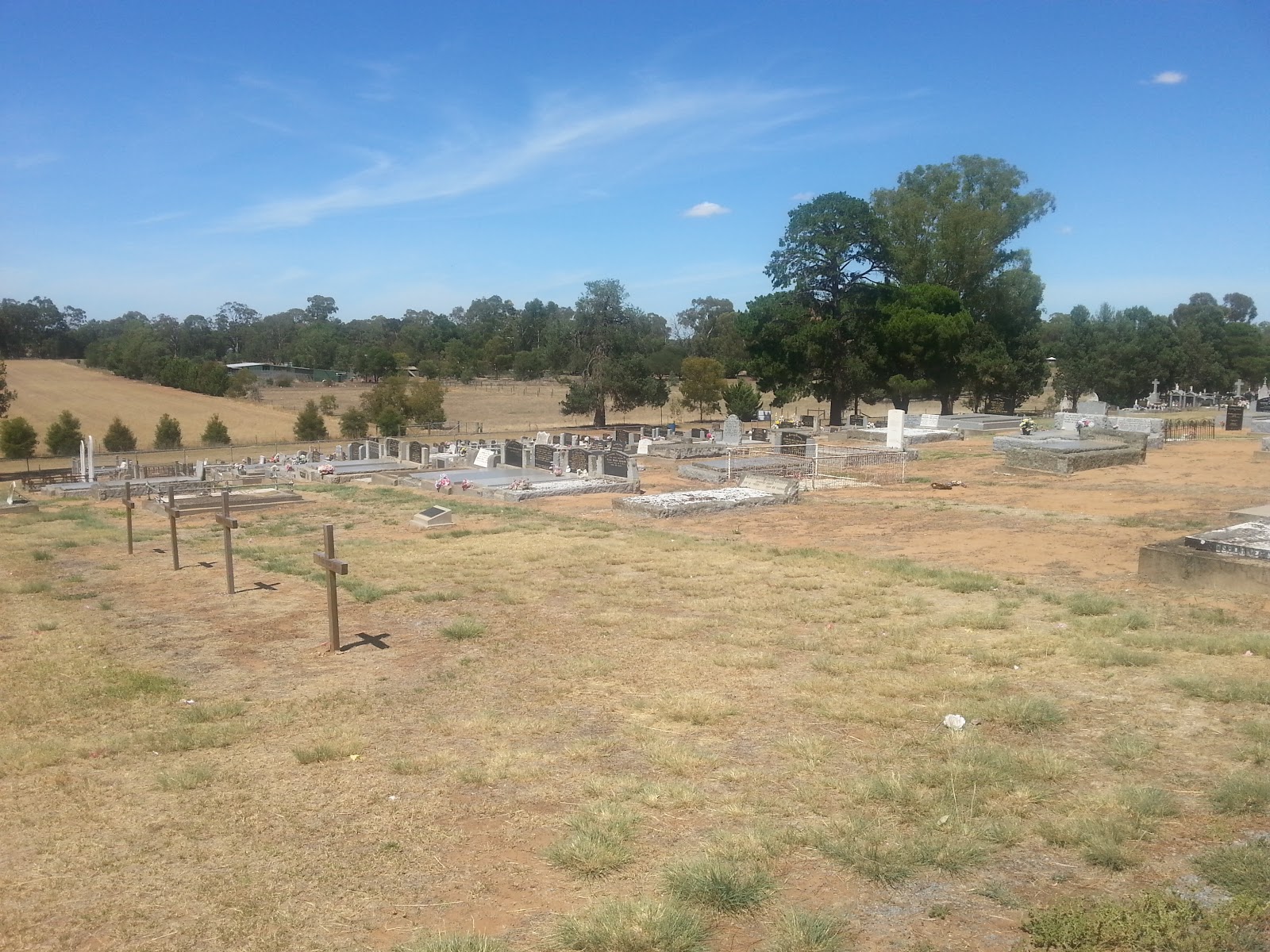
Unfortunately there is no record of exactly where JOHN aka George is buried within the Cobram Cemetery. The plot is unknown, the section is unknown and there is no headstone.

This is all the information I have for John.  He was born in Chewton and died and was buried in Cobram.  What happened in between? 

Somewhere around here, John Armstrong aka George Salter is buried.


Cobram Cemetery.


Thursday, 7 January 2016

John Armstrong - It don't matter

When I say the name "JOHN ARMSTRONG" to you, what kind of image of the man does it conjure up? For me the name Armstrong is Scottish.  Now add in that he was born in 1800, and died in 1850 in Adelaide, South Australia.  You could surmise that he was a traveller, an adventurer, perhaps drawn to the gold rush in that area when the state was very young. His occupation was a stoker, perhaps on the very ship in which he travelled to Australia. We know that many crew members jumped ship at locations where gold was found. What is your picture of John Armstrong so far?

SLSA: B 1134
Adelaide ca. 1850.  Drawing by Samuel Calvert. State Library of South Australia.

Now add to your picture that he married a young Scottish widow with an infant daughter in 1842. How do you picture him now? Finally, add in your picture that he was buried in Adelaide by the government in 1850.  We could surmise that he didn't "strike it rich" if his wife couldn't afford his burial. Now add in that he was a black African man. Wait, what?

Pre-conceptions. Mine. Armstrong = Scottish = white. I had lived with my preconceptions of a Scottish John Armstrong for a long time. As you research a person in your family tree, you can live with your own preconceived ideas for years sometimes. I got the shock of my life when I was proved so unutterably wrong.  John Armstrong was a black African man, and our family had inherited his black skin.

Previous generations of our family had very dark skin, so we have always known that there was black ancestry somewhere back in the mists of time.  We knew, for example, that John Armstrong's daughter Elizabeth had married an African man, (the elusive Sims Cummis that I have written about so many times on this blog). We have a photograph of one of Elizabeth and Sim’s children, who I discovered had the nickname “Snowy” because of his beautiful chocolatey dark skin.  Their daughter was nicknamed "Blossom" for the same reason (she was my great great grandmother). We had all presumed our family’s dark skin came from their father, Sims.  But we have no absolute proof that Sims was dark-skinned. All we know about Sims for sure is that he too was born in Africa. That fact by itself doesn’t prove that our family’s dark skin was inherited from him.

Fast forward now until I discovered a John Armstrong mentioned in an Adelaide newspaper dated 1841, describing John and his mate as "two African blacks".  I was astonished. Could this be my John Armstrong? The chances of him being my John Armstrong were good, as the population of South Australia was exploding but still only about 10,000 at the time.  John Armstrong is a common name though, and there was one other John Armstrong in Adelaide at the time.  I discovered him again in another newspaper article, this time, described as "a man of colour". Further investigation proved that yes, this particular John Armstrong was indeed my 4x great grandfather. I had made a massive, incorrect, culturally stereotyped assumption about the name Armstrong.

Although I hate the racist description in the newspaper, I am in some ways grateful for it.  It is a reflection of its own time. Without that description “two African blacks” I never would have gotten the whole clear picture of John Armstrong.  Without it, I would never have understood the full implication of the harsh realities that John Armstrong encountered over his lifetime. And the newspaper descriptions are proof enough that our family’s dark skin was inherited from Snowy’s maternal grandfather, the black African John Armstrong. (Whether his father Sims had dark skin too is yet to be verified, although it does seem likely.)

But this whole incident taught me the hardest lesson any genealogist can learn.

Keep clear what are facts in your research and only work from there.  Never make the arrogant mistake of assumption. Be on the lookout for your cultural stereotypes that are so insidious, you don’t even know that they exist. Our ancestors were individuals, and they made unique choices, so every research option must be explored in order to honour their individuality. 

Next week, John Armstrong makes his choices in Adelaide in 1840.

Historically yours,
Valerius Copernicus

PS. Recent DNA evidence shows that our African roots stem from Mali, Benin/Togo, and Senegal.


 Image from State Library of South Australia: B1134
http://www.catalog.slsa.sa.gov.au:80/record=b2064839~S1

Friday, 9 October 2015

What's in a name?

If you haven't already gathered by now, my genealogical passion centres around the puzzle of one particular branch of my mother's family tree.

My great great great grandmother was born Elizabeth Armstrong in Adelaide, South Australia in 1842.  When Elizabeth was about 8, her father John Armstrong (a black African man) died. A year later, her mother Janet (a Scotswoman) married James Salter (an Englishman) and so Elizabeth's new surname was SALTER.

The new blended family moved to Chewton, Victoria shortly after the wedding, in early response to the goldrush in the Forest Creek area.

Elizabeth Salter grew up and married a miner, named Sims CUMIS.  Sims' birthplace is listed as the Cape of Good Hope, Sth. Africa, so he is also potentially dark skinned.  The couple married in 1864 in Chewton and over a period of ten years had five children; Robert, Louisa, Ellen, James and John.

All five children were given the surname of their father, (spelled either COMES or CUMMIS as per their birth certificates). The last child was born in 1875 with that name. But as the children grew, they rejected the CUMIS name and adopted different surnames, either Armstrong or Salter, their mother's maiden surnames. And despite their marriage and five children, Elizabeth was primarily known as Salter, not her married name of Cumis until the day she died.

In fact, at her death inquest in 1896 it is noted by witness Henry Matthews that:

                      I have seen the body now lying dead and identify it as that of Elizabeth Cummis otherwise known as Elizabeth Salter.  I have known her between 5 and 6 years.

Chewton policeman Constable Luke swears:

                    That at 2.21 pm today Elizibeth Comas, otherwise known as Elizibeth Salter, aged 50 years died in her hut at Chewton.

Her death is also reported in the local newspaper, the Mount Alexander Mail:

                     An old identity of Chewton, named Elizabeth Cumas, but better known as Elizabeth Salter, died suddenly at her hut on Sunday afternoon at 2.30 o'clock.

I have written previously about Elizabeth's different surnames in the article "Elizabeth gives me a headache."

Their children all reject the CUMIS name they were born with too.

Robert Armstrong Comes dismissed the Comes and became Robert Armstrong.  He married in Chewton, moved to Charlton in Victoria, and eventually moved his family to Queensland.

Louisa used the name Louisa Salter when she married in Geelong and one of her descendants is me. Her nickname was Blossom because of her dark skin.  Her married name was Louisa Clarke.

Ellen -we are still investigating and have no definite clues as to her  (see my previous blog on this search.) At this stage we theorise that she married and changed her name. Louisa's daughter was called Ellen.

James became James Salter Armstrong, moved to Kerang and served at Gallipoli and the Western Front in World War 1.  His nickname was "Snowy" in that ironical Australian way because of his dark skin. One of Robert's sons, named James after his uncle, sadly died at the Western Front.

John used the name Armstrong but his burial details in Cobram state: also known as George Saulter. Trying to find more details in Cobram.

 No-one knows what happened to Sims after the birth of his last child in 1875. We do know he also used the name William instead of Sims. We have no death certificate for him. Nothing. The puzzle is this: WHY did the wife and children of Sims Cummis reject his name?

Historically Yours,
Valerius Copernicus
Citations:
Article identifier
http://nla.gov.au/nla.news-article199612211
Page identifier
http://nla.gov.au/nla.news-page21955428
APA citation
ITEMS OF NEWS. (1896, June 2). Mount Alexander Mail (Vic. : 1854 - 1917), p. 2. Retrieved October 10, 2015, from http://nla.gov.au/nla.news-article199612211
MLA citation
"ITEMS OF NEWS." Mount Alexander Mail (Vic. : 1854 - 1917) 2 Jun 1896: 2. Web. 10 Oct 2015 <http://nla.gov.au/nla.news-article199612211>.
Harvard/Australian citation
1896 'ITEMS OF NEWS.', Mount Alexander Mail (Vic. : 1854 - 1917), 2 June, p. 2, viewed 10 October, 2015, http://nla.gov.au/nla.news-article199612211
Wikipedia citation
{{cite news |url=http://nla.gov.au/nla.news-article199612211 |title=ITEMS OF NEWS. |newspaper=[[Mount Alexander Mail |Mount Alexander Mail (Vic. : 1854 - 1917)]] |location=Vic. |date=2 June 1896 |accessdate=10 October 2015 |page=2 |publisher=National Library of Australia}}


Friday, 14 August 2015

Ellen Cummis aka Ellen Armstrong

Hello everyone,

Today I have been researching Ellen Cummis, the sister of Louisa Cummis, my great great grandmother. As we all know, for some unknown reason, the entire Cummis family adopted either their mother's birth name, Armstrong, or their mother's stepfather's name, Salter.  My great great grandmother used the name Louisa Salter until she married.

Now about her sister Ellen.  We know Ellen was born on 24 August 1870 in Chewton, Victoria.  That is all I have ever known about Ellen since I started researching. Yet another puzzle with this mysterious family.

Today I searched the family trees on Ancestry for clues and found a tree that I believe is being researched by a distant family member.  In that tree they have the details Ellen Elizabeth Armstrong and a death certificate number, but that is all.

From the Births, Deaths and Marriages website, I got these details for that death certificate.

Ellen Elizabeth Armstrong
Parents names : unknown
No Spouse details filled in.
Age: 84
Birth Place: Victoria
Death Place: Sunbury
Registration Year: 1959

So ok, follow my logic here.

Ellen is the correct name.
Elizabeth was her mother's name.
Armstrong was her mother's maiden name.

If she was 84 when she died in 1959, that means this Ellen was born in 1875 in Victoria.  We know our Ellen was born in 1870, so it doesn't seem a match.  And yet, in all our family's research, we find over and over again that the ages of the Cummis children are out by at least a couple of years, always saying they are younger than they actually are.   So I don't find this five year gap in birth years as much of a deal breaker as I normally would.  This fudging of their birth years is consistent for this family.  And so I continue researching, bearing this in mind.

I went to the Genealogical Society of Victoria website and searched Ellen Armstrong and came up with a match to the one born in 1875.

This record shows an Ellen Armstrong was admitted to the Ballarat Base Hospital in 1898 at 23 years of age. (Again if she is our Ellen, she was actually 28 years old.) She was a dress maker and lived in Victoria Street, Ballarat and was single. Ballarat is pretty close to Chewton where she was born and her mother lived. Not a deal breaker.

There is one more thought I have.  Her death in Sunbury.  I googled Sunbury with 1959 and up came Sunbury Lunatic Asylum on Wikipedia.  That tells me so helpfully that patients were transferred from the Ballarat Asylum to the Sunbury Asylum.  So no proof yet, just some massive leaping to conclusions.

 Next step, I need to go into the GSV on Monday and look up the microfische hospital records to see what else we can find out about this Ellen Armstrong.

And I'd love to know WHY  they all changed their names.

Historically yours,
Valerius Copernicus


https://www.facebook.com/Amazingmazy

Tuesday, 21 April 2015

South Australia 1839 - Governor George Gawler

His Excellency Governor George Gawler,
Governor of South Australia in 1839.
State Library of South Australia, SLSA, B14428
Hi everyone,

You know of course from yesterday's blog that my 4x Great Grandmother Janet Slone nee Row and her first husband Robert Slone arrived at Port Adelaide, South Australia in March 1839 on the Katherine Stewart Forbes.

Also on board was Charles Cooper, who was to become the first Chief Justice of the Province.

An article by the South Australian Gazette and Colonial Register newspaper printed on 6 April 1839, just days after their arrival, tells of a welcoming speech given by His Excellency the Governor George Gawler to Charles Cooper.

It is clear from the article that both men have used this opportunity to make statements of their agendas.

Firstly, Gawler welcomes Cooper, stating that he has received the orders from her Majesty, Queen Victoria to make Charles Cooper a permanent Judge of South Australia.  Gawler sees this permanent position with 'satisfaction' and as giving rise to stability within the Colony. This stability is 'of the utmost importance to our prosperity.'  I'm getting the feeling that George has some warring parties on his hands somewhere.

George then says that Charles Cooper shouldn't have too much to do on the criminal side of things, and waxes lyrical about how the working classes of the whole British Empire are all things wonderful but especially law abiding. Er, George, where did the convicts come from in the first place?  One gets the feeling he is trying to make it so by saying so here because his next statement  was that the Gaol was full, but it was only a little Gaol.

Prophetically, Gawler speaks to our family in the next paragraph, and I'll let you read it for yourself.  He says that most prisoners in the Gaol were:

     'runaway sailors or escaped convicts from other colonies; with such as these there will, no doubt, be something to do.  An efficient police must be maintained, and the arm of justice firmly extended to repress their irregularities.'

Well, Janet Slone's next husband, and my 4x great grandfather John Armstrong,  is an African born sailor, who we think gets done for theft of four chickens, and ended up doing hard labour in that Gaol a few years after this speech.

Next, Gawler talks about a propensity for 'frivolous and vexatious litigation' within the colony which he hopes is replaced by conciliation and arbitration.  He hopes that Mr. Cooper will not have to deal with too many of these civil cases.

Cooper himself responds now, thanking the Governor for the cordial reception, and said that 'everything had been done to make him forget that he was a stranger in a strange land.'  I wonder if Granny felt the same way.  Cooper then went to some effort to emphasise that, by necessity, his position required him to be apolitical.

Then he commented on a situation of which I have no knowledge, but Mr. Cooper states that he has read something in the newspapers that is 'so unjust to the Governor' and 'so injurious to the happy progress of the colony.' What is Charles Cooper talking about?

Another mystery to solve.

https://www.facebook.com/AmazingmazyHistorically yours,
Valerius Copernicus

Image of Governor Gawler supplied courtesy of State Library of South Australia, SLSA. B14428.
Newspaper articles found in Trove reproduced courtesy of the National Library of Australia.
Citation for Trove article:


Article identifier
http://nla.gov.au/nla.news-article31750510
Page identifier
http://nla.gov.au/nla.news-page2052662
APA citation
APPOINTMENT AND INSTALLATION OF HIS HONOR THE JUDGE. (1839, April 6). South Australian Gazette and Colonial Register (Adelaide, SA : 1836 - 1839), p. 3. Retrieved April 22, 2015, from http://nla.gov.au/nla.news-article31750510
MLA citation
"APPOINTMENT AND INSTALLATION OF HIS HONOR THE JUDGE." South Australian Gazette and Colonial Register(Adelaide, SA : 1836 - 1839) 6 Apr 1839: 3. Web. 22 Apr 2015 <http://nla.gov.au/nla.news-article31750510>.
Harvard/Australian citation
1839 'APPOINTMENT AND INSTALLATION OF HIS HONOR THE JUDGE.', South Australian Gazette and Colonial Register(Adelaide, SA : 1836 - 1839), 6 April, p. 3, viewed 22 April, 2015, http://nla.gov.au/nla.news-article31750510
Wikipedia citation
{{cite news |url=http://nla.gov.au/nla.news-article31750510 |title=APPOINTMENT AND INSTALLATION OF HIS HONOR THE JUDGE. |newspaper=[[South_Australian_Register|South Australian Gazette and Colonial Register (Adelaide, SA : 1836 - 1839)]] |location=Adelaide, SA |date=6 April 1839 |accessdate=22 April 2015 |page=3 |publisher=National Library of Australia}}


Sunday, 5 April 2015

Cobram and the man with two names

If you've been following my blog, you will know of my search for my great great grandmother's siblings.

To our knowledge there are five children in the family altogether.  Reading their mother's inquest papers though throws that in doubt - a close friend testifies that she had seven children.  Could we have missed two whole children somehow?

One of the people we are looking for is John, and you will note I recently found a hospital record in Castlemaine when he was a child.  He was using his mother's surname, as all the children of that family did.  They all used their mother's maiden name, Armstrong, or her stepfather's surname that she adopted until the end of her days, Salter.

I was using the Genealogical Index of Names via the GSV website, looking at the Cobram Cemetery Burials when I found a John Armstrong, being buried in Cobram in 1931.  We knew John's death record showed he died in Cobram in 1931.  Then I read the rest -  "Also known as George Saulter".

George Saulter! So John is now also known as George!  Another clue to chase up.
The Cobram Historical Society is the real hero in this research. Volunteers spend time transcribing records just so people like me can discover the information they glean from dusty papers.  Whoever did so; whoever went to the extra trouble of putting the extra detail  of George Salter AND cross referencing it...thank you. Thank you so much.

Historically yours,
Valerius Copernicus


Thursday, 2 April 2015

Sweet success - John Armstrong

Hi everyone,
Today I started using the member's section of the Genealogical Society of Victoria's website.  And Bingo!

We have been looking for my great great grandmother's brother John for a long time, and had only found his birth and death records.

The trouble with researching this family all along has been their multiple use of surnames.  They were born with the surname CUMMIS, but for some reason unknown to us, all the children adopted the use of their mother's birth name, ARMSTRONG or her step-father's surname, SALTER.  She used her step-father's surname of Salter until the day she died.  Even in the newspaper upon her death she is referred to Elizabeth CUMMIS better known as Elizabeth SALTER.

My great great grandmother Louisa was born CUMMIS but married as Louisa SALTER.  Her brother was born James CUMMIS but was known later as James Salter ARMSTRONG.  Another brother Robert was born Robert Armstrong COMES, but later in life dropped the Comes and became Robert Armstrong.  His descendants are all ARMSTRONG.

In looking for brother JOHN, I presumed he would adopt the name Armstrong as his two elder brothers did, and that was correct.  His death records do show up as John Armstrong.  However, it hadn't occurred to me to search under the name SALTER for John, and when I did, there he was.

John SALTER was admitted to Castlemaine Mt. Alexander Hospital on 4 Jan 1886 when he was 10 years old.  He was there for about 10 days and was discharged cured.  We will have to research more to find his diagnosis.  He was recommended to the hospital by a Mr. Carbarns, who, five years later, also recommended John's mother Elizabeth be admitted to the same hospital for Rheumatic fever.  We will have to research who Mr. Carbarns is.

I know it is just a hospital record.  I know it is not a huge event in John's life.  But the thrill of discovery and that electric realization that you've found a piece of that puzzle is one that all family historians live for.

Historically yours,
Valerius Copernicus.


Monday, 30 March 2015

A chook stealing John Armstrong in Adelaide in 1842

Tell me everyone, how I can identify my 4 X great grandfather John Armstrong?  With such a widespread name as Armstrong and such a common name as John, how do I separate my John Armstrong from any other?

In 1834, South Australia separated from the colony of New South Wales.  Land was being released for the first time.  Commissioners were appointed to control land sales, revenue and the flow of emigrants in 1835.  There were only 546 Europeans in the province of South Australia in 1836.  The colony was small in those days; therefore there is less chance of multiple people with the same exact name.  But with a name like John Armstrong, how can we be sure?

We know for a fact that John Armstrong married my 4 X great grandmother Janet Slone nee Row in 1842 in Adelaide. He was her second husband.  Janet (yes, the same Janet as yesterday's blog!) gave birth to my 3 X great grand mother Elizabeth Armstrong.

We know a John Armstrong was buried in West Terrace cemetery, Adelaide in an unrecorded location on 8 February 1850.  He was aged 50 when he died and lived at 50 Waymouth Street, Adelaide.  His burial was paid for by the state.  

Another search of John Armstrong turns up a newspaper article about criminal proceedings in 1841 for theft. This John Armstrong was indicted with accomplice Charles Hall for stealing four chickens.  There is an amusing account of the policeman following footprints and chook feathers back through the bush to the hut and taking the chook heads and feet back to the farmer to identify.  The policeman also mentions small children in the hut, and this information tallies with what we know of Janet's Slone family. Then again, lots of people have children.  ie. We can neither confirm nor deny.

Another time the same Charles Hall and John Armstrong get done for stealing clothes from a Mrs. Hall although the ineffectual John tried to stop Charlie, who complained bitterly at John's lack of experience and ineptitude.  The interesting thing in this case is that Charles Hall and John Armstrong are both black-skinned Africans. The records mention John lives near the Brown Hill Creek.  

It is certain that the chook stealers and the clothes stealers living in a hut in the bush are the same people.  They are black African men, it says so in the court records.  The interesting thing is that we know Janet's child Elizabeth Armstrong, my 3 X great grandmother later married a black skinned man born in Africa. Like her father?  We don't know. It is only an interesting fact because as all family historians know, patterns occur over generations.  

So we have three John Armstrongs.  Our great great great great grandfather that married Janet Slone in 1842 is definite.  The one that died 1850 buried in West Terrace is a probable because we know Janet was a widow when she remarried in 1851. And lastly, the third John Armstrong that got done for chook theft. How do you prove that he was the only John Armstrong in Adelaide in the days of less than perfect record keeping?

Historically yours,
Valerius Copernicus

PS. I think he is all the same person; I just can't prove it.